可編程控制器PLC 在過程自動(dòng)化中的重要應(yīng)用
詳細(xì)介紹
PLC 在過程自動(dòng)化中的應(yīng)用還體現(xiàn)在其能夠?qū)崿F(xiàn)復(fù)雜的控制算法和邏輯功能。它可以通過編程實(shí)現(xiàn) PID 控制、模糊控制、自適應(yīng)控制等先進(jìn)的控制算法,對(duì)具有非線性、時(shí)變性和不確定性的過程對(duì)象進(jìn)行有效的控制,提高過程控制系統(tǒng)的性能和穩(wěn)定性。此外,PLC 還可以實(shí)現(xiàn)順序控制、連鎖保護(hù)等邏輯功能,確保生產(chǎn)過程的安全性和可靠性。0
The Important Application of Programmable Logic Controller (PLC) in Process Automation
In the field of process automation, programmable logic controllers (PLCs) also play an irreplaceable and important role, widely used in industries such as chemical, petroleum, power, and water treatment.
In the chemical production process, programmable logic controllers (PLCs) are used to control various parameters such as temperature, pressure, and flow rate of chemical reactions, ensuring that the reactions proceed under safe and stable conditions. For example, in the control of distillation columns in petrochemicals, PLC achieves the separation and purification of various components in the distillation column by adjusting parameters such as feed rate, reflux rate, and heating amount, ensuring that product quality meets standard requirements.
In the power system, programmable logic controllers (PLCs) are used for unit control in power plants, automation monitoring in substations, and scheduling management in the power grid. It can monitor the operating status of the generator in real time, control the excitation system and speed control system, and ensure the stability of the output voltage and frequency of the generator. At the same time, PLC can also control and monitor the switchgear and protection devices of the substation, achieving automated operation of the power grid and rapid fault handling.
In the water treatment industry, PLC is used for production process control in sewage treatment plants and water treatment plants. In the process of sewage treatment, PLC can control the operation of aeration equipment, water pumps, sludge treatment equipment, etc., achieving precise control of the biochemical treatment, sedimentation, filtration and other process links of sewage, ensuring that the effluent quality meets the discharge standards. In the water treatment plant, PLC can control the processes of raw water intake, purification, disinfection, etc., ensuring the quality and safety of water supply.
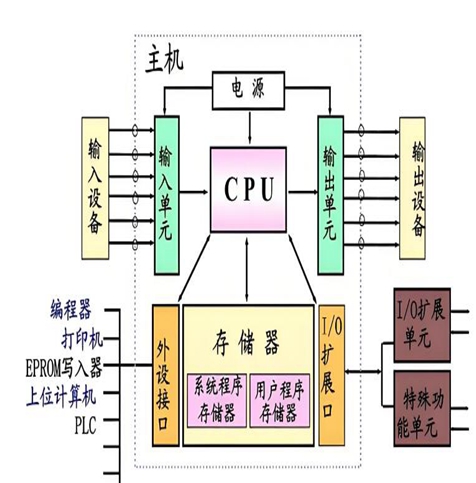
The application of PLC in process automation is also reflected in its ability to implement complex control algorithms and logic functions. It can implement advanced control algorithms such as PID control, fuzzy control, and adaptive control through programming, effectively controlling process objects with nonlinearity, time-varying, and uncertainty, and improving the performance and stability of process control systems. In addition, PLC can also achieve logical functions such as sequential control and interlock protection, ensuring the safety and reliability of the production process.